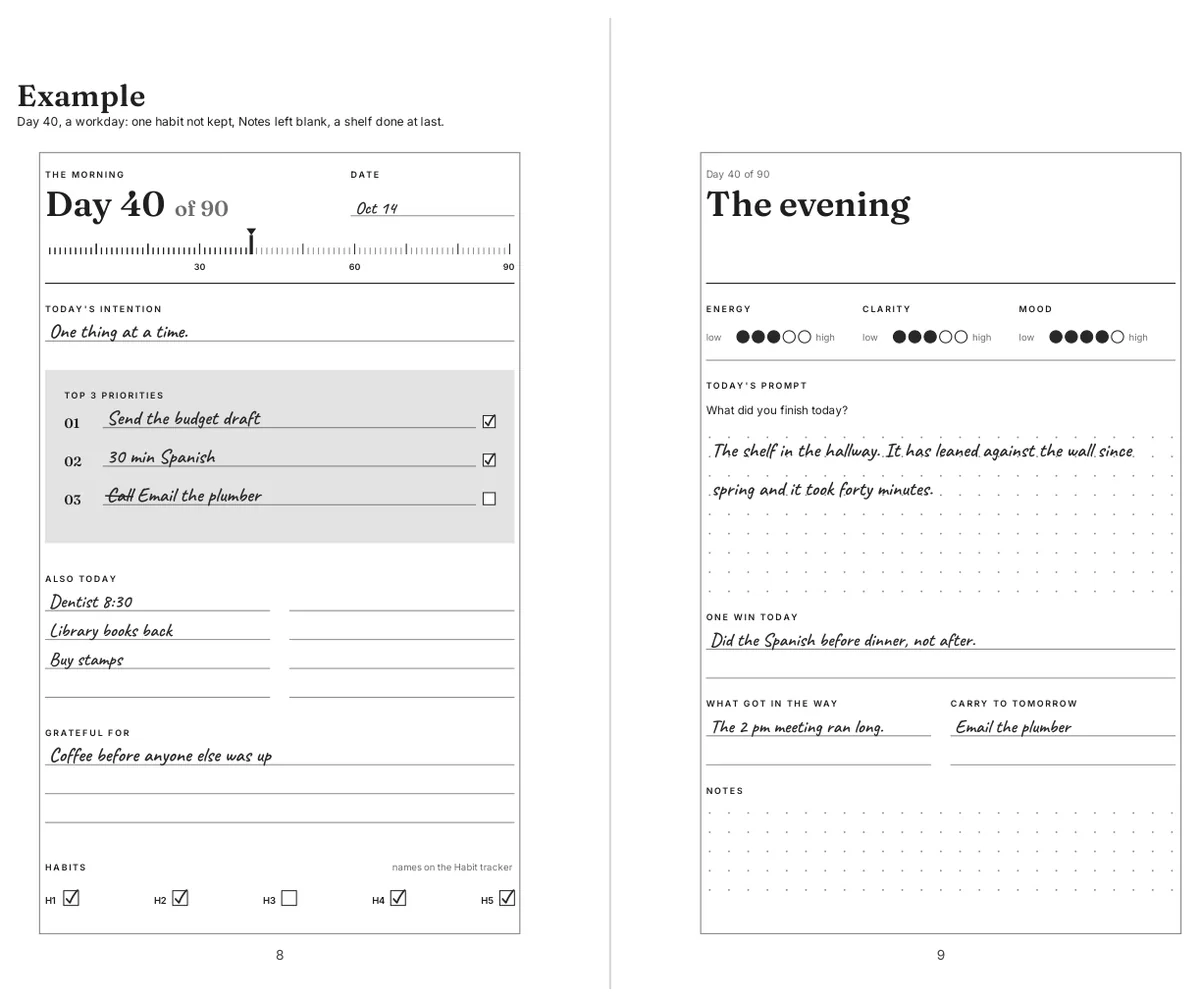

How to use a 90 day journal, from the first page to day 90
A plain walkthrough of a 90 day journal: the start pages, the daily spread, the weekly review, the checkpoints, and what to do when you miss a day.
Read full article
Each journal keeps one thing in one place for ninety days: a recovery, a habit, a treatment, a goal. A two-page spread for every day’s entry, and review pages along the way.
How a journal works
Two facing pages for each of the ninety entries: a day, a session or a workout, depending on the journal. Ticks and circles where you can, lines where you need them.
Every entryIn 22 of the 24 journals, two pages after every seventh day look back at the week. The Workout Logbook and the ADHD Focus Planner pace theirs by workouts and sessions.
Along the wayMissed a day? Leave it blank and start again today. Nothing in these journals needs catching up.
Whenever you returnThe ninety-day cadence
A whole year is hard to keep in view, and one week is too short to see a change. Ninety days sits in between: about three months, one season, a quarter of the year. A stretch with a clear start, a middle and an end.
Three months is a stretch you can hold in your head. Today’s page is never far from the first one or the last, so the whole run stays in sight.
Ninety days gives you busy days and quiet ones. Time to see what holds, what does not, and to change it halfway.
Ninety days is about a quarter of the year: a natural place to begin, a natural moment to stop and look back, and a natural time to decide what comes next.
How The 90 Day Journal is built
An eight-page start comes first: three goals, five habits, your starting numbers and a plan for week 1. Then a two-page spread every day, and a weekly review after every seventh day.
Day 30: a checkpoint to look backAt the day 30 checkpoint you keep, swap or drop habits and set goals for the next thirty days. Then thirty more days of daily spreads and weekly reviews.
Day 60: a second checkpointThe last thirty days end with a count of your habits and priorities, then Look back and Look ahead: compare with your starting numbers and decide what the next 90 days are for.
Day 90: look back and look aheadOther journals in the series are laid out for their own topic; each journal’s page lists what is inside. See The 90 Day Journal
Anatomy of a spread
This is the daily rhythm of The 90 Day Journal, the first journal of the series: a morning page on the left, an evening page on the right, and the back cover asks for five minutes morning and evening. Other journals lay out their pages for their own topic. See The 90 Day Journal.
The morning · left page
The evening · right page
Every seventh day
The book itself
Every journal in the series is a 6 x 9 in paperback with a black-and-white interior. The page count and the pages differ from book to book.
The journals
All 24 are 6 x 9 in paperbacks with a black-and-white interior, printed and sold by Amazon. Listings coming soon.
 Home readings & medicines tracker Blood Pressure Ninety days of readings, taken the same way each day.
View journal
 Paired meal testing, A1c & habit tracker Blood Sugar Ninety days of readings, meals and questions, on paper.
View journal
 Heart confidence, medication & rehab tracker Cardiac Recovery A daily record of numbers, medicines and questions.
View journal
 Recovery, exercise & pain tracker Knee & Hip Replacement The first ninety days of recovery, in one place.
View journal
 Gastric sleeve & bypass recovery tracker Bariatric Surgery Ninety days of meals, sips and supplements, one small bite at a time.
View journal
 Dose, protein & side-effect tracker GLP-1 Companion Ninety days of protein, side effects, shots and the wins the scale misses, in one place.
View journal
 Headache diary & possible-trigger tracker Migraine & Headache Ninety days of clear notes for your next appointment.
View journal
 Pain, fatigue & pacing tracker Chronic Pain & Fibromyalgia Ninety days of gentle notes for you and your doctor.
View journal
 A guided 90 day tracker Gut Health & Symptoms Ninety days. Every meal, every symptom, in one place.
View journal
 Treatment, medicines & appointments tracker IVF & Fertility Ninety days, held in one calm place.
View journal
 Symptom, sleep & cycle tracker Perimenopause Ninety days. Look for your patterns. Bring your own record to the appointment.
View journal
 Fourth trimester log for mother & baby Postpartum Recovery Ninety days. Your baby’s rhythm on the left. Your recovery on the right.
View journal
 CBT thought records & exposure steps Anxiety & Panic Ninety days. Test the worry. Take the step. Write down what happened.
View journal
 CBT-I sleep diary & evening wind-down Sleep Reset Ninety nights. Put the day down. Write the night down.
View journal
 After a loss · gentle, undated, in your own time Grief Ninety entries for the days you need them. No deadline. No right way.
View journal
 A 90 Day Nervous System Journal Somatic Reset Ninety sessions of noticing your body’s signals, even on 10% battery.
View journal
 Alcohol-free & mindful drinking tracker Sober Curious Ninety mornings. Ninety evenings. Yours to read.
View journal
 Quit or cut down · One habit, ninety days Dopamine Detox Ninety days. Name your triggers. Plan for the urge.
View journal
 Cashflow detox & challenge tracker No-Spend Ninety days. What you spend, why, and what you keep.
View journal
A guided journal The 90 Day Journal Ninety days. Three goals. One day at a time.
View journal
 Vision, identity & daily action Dream to Reality Ninety days. One dream. One brave step a day.
View journal
 A journal for solopreneurs and builders Quarter Sprint One quarter. One North Star. Ship it.
View journal
 A guided 90 session planner ADHD Focus Planner Ninety sessions. No guilt. Restart anytime.
View journal
 Strength & hypertrophy Workout Logbook Ninety workouts. Every set on paper.
View journal
From the journal
A plain walkthrough of a 90 day journal: the start pages, the daily spread, the weekly review, the checkpoints, and what to do when you miss a day.
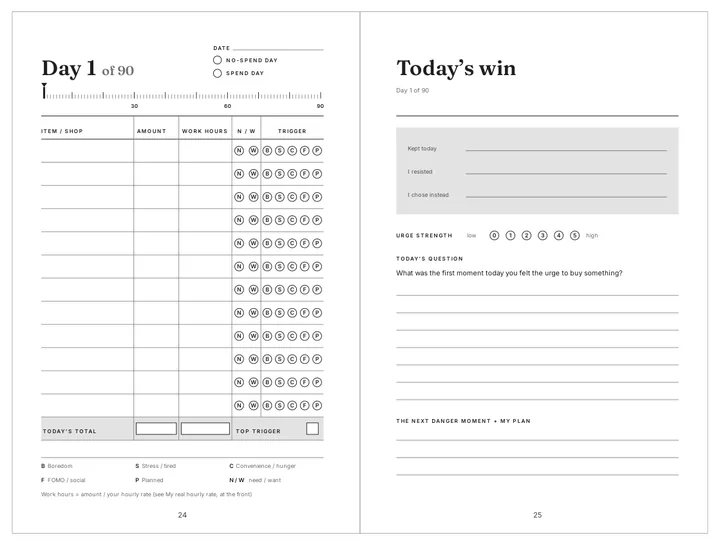
How The 90 Day No-Spend Journal structures ninety days: your own rules, a daily spending log, the 90-day path, weekly reviews and two checkpoints.
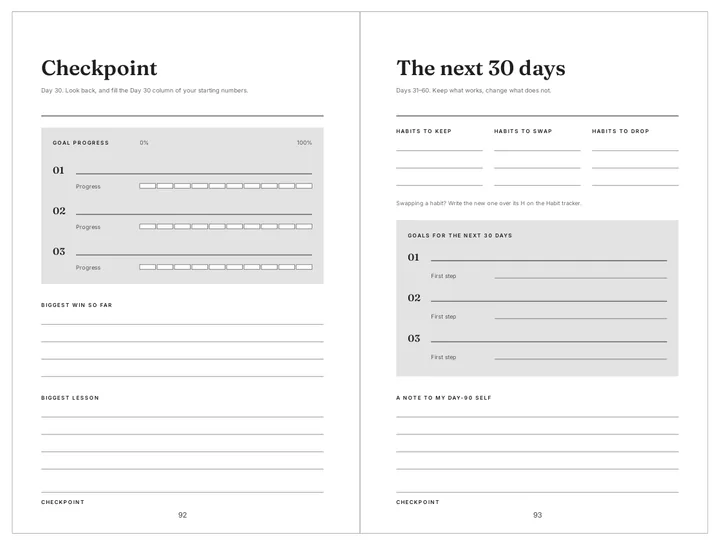
After day 30 the journal stops you for a checkpoint. What the two pages ask, a sensible order to fill them in, and how to keep, swap or drop a habit.
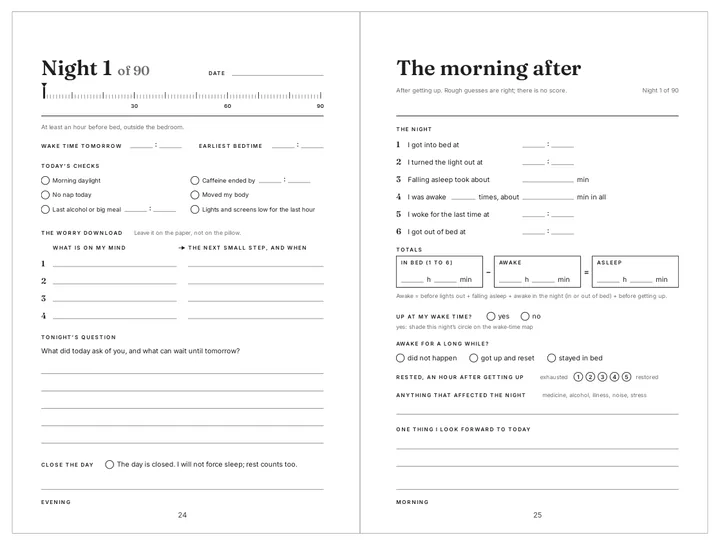
A tour of The 90 Day Sleep Reset Journal: the evening page, the two-minute morning log, the wake-time map and the weekly review. Not medical advice.
The health journals keep a neutral record for you and your care team: what you measured, what you took, how the day went. The closing pages gather the ninety days into a summary to take with you.
They give no medical advice, no doses and no target values. Anything that is a limit or an instruction is a blank for you to fill in with what your own care team told you.
Good to know
Leave it blank and pick up today. Nothing in these journals needs catching up.
Every journal is a 6 x 9 in paperback with a black-and-white interior, printed and sold by Amazon. Each day has its own space, and each journal’s page lists what is inside.
On Amazon. The listings are coming soon: each journal's page will show a Buy on Amazon button as soon as its listing is live.
No. They give no medical advice, no doses and no target values. Anything that is a limit or an instruction is a blank for you to fill in with what your own care team told you.
Register the date you began and you get a one-page card to print and fill in by hand. Emails are planned but none are sent yet.